
Two releases, five weeks, 185 pull requests merged across the monorepo and 75 commits in the dashboard’s own release range. v0.3.5 and v0.3.6 are the tags for everything after v0.3.4 — and the through-line is that chmonitor got a lot better at telling you when something is wrong, and a lot quieter about everything else.
chm add, chm ls, chm use — named connections on your own machine, no dashboard round-trip.PeerDB learned to alert
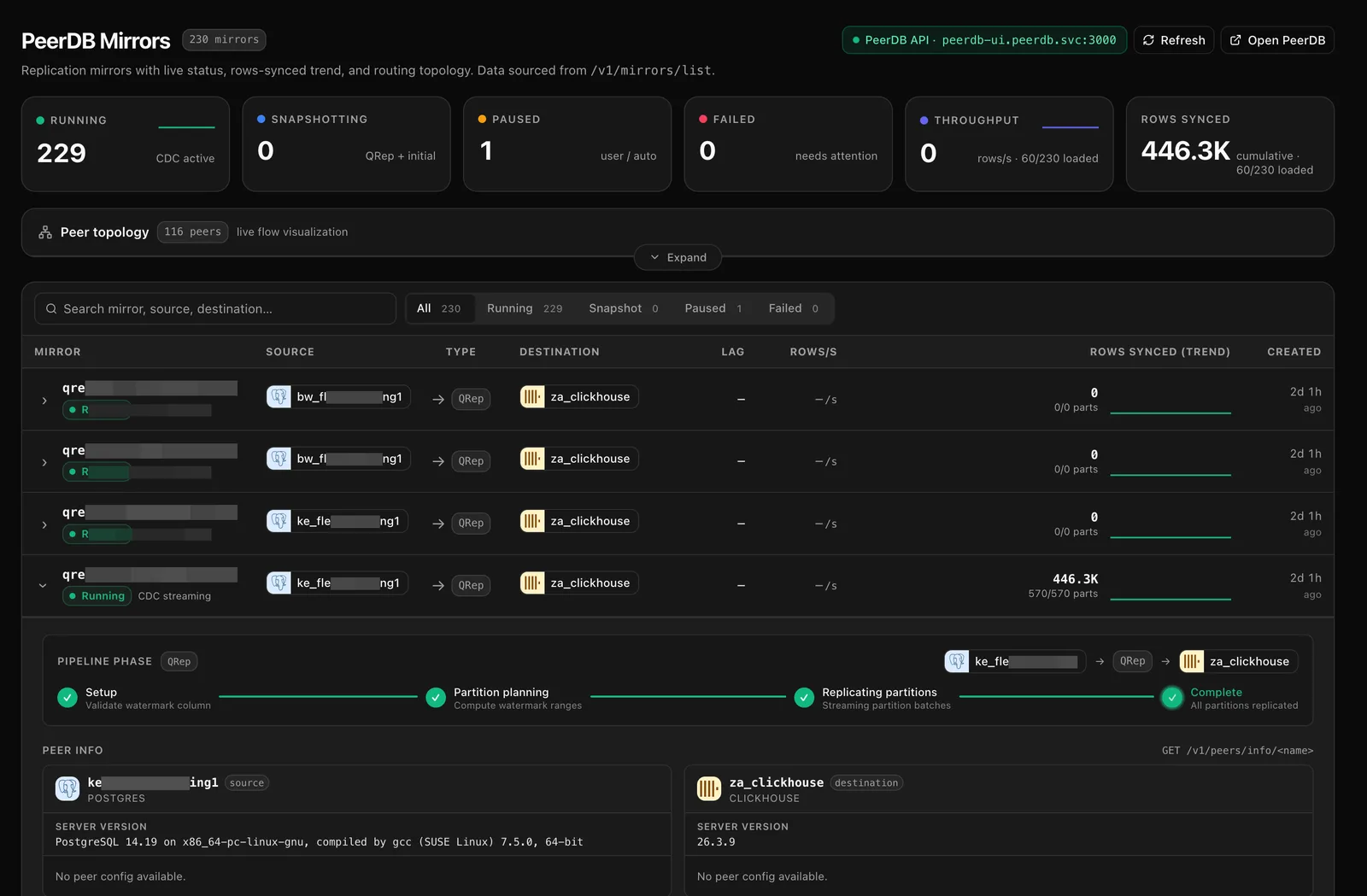
PeerDB has been a monitoring surface since July — mirror status, CDC batch history, lag triage, slot health. What was missing was the last step: telling you when a mirror goes bad without you going to look.
v0.3.5 shipped a runtime alert cycle — a collector, an orchestrator, and sweep dispatch wiring — on top of alerting that classifies a finding, formats it, validates it, keeps an audit trail, and investigates before delivery. That last part is the one worth naming: the system is expected to try to explain an alert before it pages you, so the notification arrives with a cause attached rather than a bare threshold breach.
Alongside it: read-only fleet metrics, a read-only mirror-status tool for the AI agent, and a batch of fixes closing auth and cache-isolation gaps.
Alerts you can point at your own endpoint
Health-alert findings can now go to destinations you declare, per deployment.
The Helm chart renders an optional alertWebhooks block into the
HEALTH_ALERT_WEBHOOK_TARGETS contract — non-secret fields as JSON in the
ConfigMap, URLs and secret headers as Secret-backed env vars, never in the
ConfigMap:
alertWebhooks:
  enabled: true
  targets:
    - name: team-alerts
      url: "https://hooks.example.com/…"
      headers:
        - name: X-Source
          value: chmonitor
URLs must be https://; plain HTTP needs an explicit allowInsecureHttp opt-in
per target, because a webhook ships operational detail about your cluster to
whatever URL you name. The whole block is disabled by default, so Docker and
OSS behaviour is unchanged until you opt in. Targets saved through the UI merge
with the GitOps-declared ones by name and win per-field; secret references
always resolve from the deployment environment. The legacy global
HEALTH_ALERT_WEBHOOK_URL keeps working unchanged.
chm learned local connections
The standalone Rust CLI can now hold named connections on your own machine:
chm add      # save a ClickHouse HTTP or postgres:// URL as a named connection
chm ls       # list them
chm use      # switch the active one
chm rm       # remove one
This is the piece that removes the last reason to keep a tab open. Before, every
diagnostic meant pasting a URL into the dashboard; now the connections live
locally, chm doctor checks them, and the dashboard is somewhere you go when
you want a picture rather than an answer. Replica nodes are not counted as
separate hosts for licensing — they are the same cluster.
The sidebar got quieter
The Essential first-run sidebar shows the pages you use daily and folds everything else away, with hover-+ to add a sibling back and a More flyout for the full catalog. Group headings open a per-category dialog rather than dropping you into a forty-checkbox wall. It is all reversible, and Settings → Workspace → Navigation still has the Full / DBA / Engineer / SRE / Custom roles.
The long argument for why a DBA, an SRE and an engineer should not share a sidebar is still A DBA, an SRE, and an engineer should not share a sidebar.
The unglamorous half: we hardened the public surface
Some of the most valuable commits in this range are not features.
- ClickHouse host credentials are redacted from public API responses.
hostIdis validated at the route boundary and public-route error handling no longer leaks internals.- Public probe endpoints got auth and rate-limit guards. These are the endpoints that were easiest to hammer.
- Device, cron and API-key auth surfaces were hardened, with route tests.
- Advisor batch queries were fixed for correctness and sanitised, and the weekly report now integrates with them.
None of that shows up in a screenshot, and all of it matters more than most features do.
Upgrading
Nothing here changes how you connect. CLICKHOUSE_HOST, CLICKHOUSE_USER,
CLICKHOUSE_PASSWORD and CLICKHOUSE_NAME are unchanged from v0.3.4, and the
NEXT_PUBLIC_* → VITE_* migration from v0.3 still applies if you have not done
it — see Migrate to v0.3.
docker pull ghcr.io/chmonitor/chmonitor:0.3.6Pin it, and pin the chart at 0.2.16 if you are on Kubernetes.
Every page mentioned above opens on the live demo at
dash.chmonitor.dev — the PeerDB section at
/peerdb, the agent settings at /agents, and Health at /health.